Saturday, March 11, 2006

Vitamin D

Spring at last. At least for today. I'm not a sun worshipper - my northern European bloodlines don't allow me to last long out there. But a small dose on a March afternoon was just what the doctor ordered.

Lowering My Standards

When I started blogging, I was told that you can spot the newbies by their voluminous postings. That veterans know you have to pace yourself. But as my boss reminded me this week, pacing is something I'm not particularly good at.

I seem to have reversed the pattern. I've been dreading posting lately, putting it off because it has begun to intimidate me. A trip back in time demonstrated one of the reasons.

Early posts seemed to average a few hundred words. 400-500 on a good day. Lately, I've topped 1,000 on a frighteningly regular basis. (And I'm not including the infamous 'auditions comments' postings, because those are computer generated from previous writing.)

The other thing I've done is to take it too seriously. A peculiar talent, taking a good thing to its illogical extreme and killing it off. There's been a lot of writing/rewriting/editing/censoring going on because I'm seized by the compunction to assess everything from my readers' various points of view - students, teachers, colleagues, performers, patrons, friends, enemies. (Not really enemies of course, but paranoia keeps us humble.)

Just 'splaining this for my regular readers, in case you wonder why I may be about to turn terse :)

Random Observations

St. Lawrence String Quartet last night. Who'd have thunk that a bunch of mild-mannered Canadians could dig into Beethoven Opus 131 with such abandon? If you like your chamber music genteel, it probably wasn't for you. But Beethoven would've loved it.

Still ruminating on a piece in the NYTimes a couple of weeks ago about teenagers and 'classical' music. I'd send you there, but the link has expired. My preoccupation with the content has to do with the way that article didn't bypass the significant generational and cultural difficulties with getting "younger" patrons in the seats. Forget teenagers... I'd be happy with a bunch of 30-year-olds. And it's not about content, it's about delivery. About the experience and the trappings more than about the music.

Thank goodness no one has invented a laptop screen that's functional in full sunlight. (Or if they have, I can't afford it.) Spent my time in the sun plugged into a Tancredi recording. Have to give a linear and intelligible talk on it in a few days, and because I've never seen it (!), I have some serious catching up to do. Wasn't prepared to like it as much as I do.

Caught a bit of Forza on the Met broadcast. Made me shudder as usual. My formative experiences with the big Verdi monsters were not generally positive. Forza, Aida, Trovatore, Don Carlo, Luisa Miller, Otello in less than 5 years. I was still wrapping my mind about opera, period, and I should've been weaned on less stiff stuff. Some great music to be sure, but the lingering impression was a blur of cranky high-maintenance divas and divos, unhappy conductors, unreasonable directors, dimly lit gray stone sets, nightmarish backstage cues, and ice-cold fear because I had no idea what I was doing. Yes, I know, too harsh. But it's taken me half a lifetime to get past it and realize how drop-dead gorgeous these pieces are.

Hope it's springtime wherever you are. See you in a few days.

Thursday, March 09, 2006

Technology as Metaphor

“This server is currently experiencing a problem. An engineer has been notified and will investigate.”

I haven’t posted since Sunday and was starting to feel seriously negligent, but my desperate midnight attempt to blog was met by “server problems.”

It’s a Sign.

An omen. A metaphor for the rest of my life at the moment.

The entire evening was full of thwarted technological adventures.

Job 1: Transcribe the audio recording of the interview I did this afternoon with Emil de Cou about the National Symphony Orchestra’s upcoming concerts at Wolf Trap.
Obstacle 1: The mini-disc battery quit on me, and I realized I had left the AC adapter at the office.

Job 2: Choose excerpts from last summer’s operas to submit as work samples for a grant funding proposal that’s due in a few days.
Obstacle 2: The DVD recorder won’t work without the remote, and said remote has gone missing.

Job 3: Burn CDs onto laptop in order to pull 30-second excerpts for web page audio clips.
Obstacle 3: This probably would’ve worked if I hadn’t insisted on doing it at the same time I was trying to download photos and press kits for booking sheets for next season’s chamber music series.

Job 4: Blog.
Obstacle 4: “An engineer has been notified and will investigate.”

All while nagging my son to read his “Taming of the Shrew” assignment for tomorrow, attempting to make a small contribution to my husband’s repertoire dilemma for his upcoming English choral concert, and reassuring my daughter that it’s OK if she doesn’t get everything done that she hoped to during spring break. (The nut doesn’t fall far from the tree.)

Since you’re reading this, that means the server is back up and running. Gotta love those folks at Blogger – the status page says “The offending server is being replaced and then shot.”

Tomorrow’s another day. Maybe I’ll post something of substance. Or I will put every piece of godforsaken technological crap that I own in a pile and pour gasoline on it.

Sunday, March 05, 2006

Here We Go Again

Audition comments are back. Mostly because blogging is taking a back seat to my actual work, on which I am woefully and almost irretrievably behind.

Photo at the left from a break during Friday's chorus auditions, which went very well, thank you!

Comments are excerpted but unedited, randomized so that they're anonymized. (I know that's probably not a word, but the other day someone asked me to "calendarize" an appointment, so anything goes...)

  • This voice would speak better in another hall; it needs a little cushion
  • The instrument has more promise that most, and she’s fearless and focused, but there’s a lot of refinement to be gained
  • She’s reasonably animated when she speaks, but she goes into that “serious singer place" during the arias, though.
  • I hope and trust that she will come into her own. For that matter, that [insert name of conservatory here] is the right place for her.
  • I don’t really think Blondchen is her thing; she actually has more to offer in other areas, and others do the high E thing better
  • Is very busy during hard moments - almost totally drops characterization
  • A little stressed out by the coloratura, but managing; he’s more than a bit stuck physically, and it intensifies when he worries about the vocalism
  • One of the few times I’ve ever been convinced of this [Baby Doe’s Silver aria] as a viable piece of theatre
  • Singing this with investment and expression but without over-indulgence. Good for him.
  • I think the holes in the line are technical, and she’ll learn to fix them. So many great moments. Top is so strong. Great stage presence.
  • Gotta get rid of this recit.... it’s over 4 minutes long… Not going to have time for a second aria.
  • Getting spooked by the first aria. If you scare easily, you shouldn’t offer to start with something like this.
  • Doesn’t have the maturity to flesh out this scene, but the opulence of the voice goes a long way.
  • He communicates. Thank you. And phrases, thank you again.
  • Fix the French
  • Angular phrasing, has trouble at the end of phrases - interrupts her sound.
  • To her credit, it’s a big voice, but it’s finding precious few of these pitches
  • It’s a little of the clutch and stagger school, but it’s not pasted on… she really feels it this way
  • His body seems devoid of energy; totally disconnected from the singing in every way
  • The world needs basses, so let’s hope he keeps working hard
  • She’s trying so very very hard on every level with little payoff; it’s almost painful to watch
  • Coloratura is messy. Hard to tell if it’s the wobble or a moving note.
  • Getting totally flustered. I am not sure she is going to make it through this. Not ready for auditions.
  • Fix the German
  • Opening cadenza was kind of like jazz, and not in a good way
  • Has no clue what to do with her arms. Would benefit from seeing herself in a video.
  • Should not offer a bel canto aria in audition yet. Showcases all her shortcomings.
  • Will have to fight again his lyric tendencies; he has energy, but hasn’t figured how to really use it.
  • The top isn’t there yet, and neither is the coloratura; how hard is she willing to work?
  • Thought she’d sing the Mozart honestly, but even it is chock full of faux touches and compromises…throwing all of her eggs into the acting basket
  • Uh-oh. Old aria, bad habits. Like a different person singing... Is that his teacher at the piano? She looked directly at us during the first melisma to check our reactions.
  • Pulling off the voice a lot, scooping and swooping; language is chopped and diced the wrong way.
  • It’s a fairly mature old world approach, with significant accommodations, and a patchwork technique, but lots of heart.
  • Not a bad instrument, but everything is out of focus; the technique, the language, the style, the phrasing......
  • Some phrases very beautiful, other sag. Easy top. Nice ornaments. Can easily float and control top.
  • There’s absolutely nothing wrong with this voice, but she has very little to say musically, and this is such a crowded Fach.
  • Triphthong on the final E vowel.
  • Who told her that it’s OK to sing this?
  • Can’t understand a word.
  • He’s got spunk. Gotta love it.
  • Fix the Italian.

Wednesday, March 01, 2006

Aviaries and Tuning Forks

Maybe it was turning the calendar over to March that did it. But it's all about the birds today. The robins have come back to the bird feeder outside my office window. The cardinal that spent the entire winter bashing himself against said window has mysteriously and thankfully moved on. And the woodpecker that marks his territory every spring by drilling on the southwest corner of our house woke me up this morning.

Weather's still chilly in these parts, though. And in a way, that's good. I seem to have developed this slightly panicked visceral reaction to unseasonably warm weather in the spring. Warmth = summertime = curtain up! And we're clearly not ready yet for the last part of that equation.

The List

Chorus auditions tomorrow and Friday. Lots of spots to fill this year. SATB in all 3 shows. Ordered the supertitle projection equipment yesterday. Contacted our improv coach at Comedy Sportz about prep for Instant Opera. Got a huge and important funding proposal put in the mail yesterday afternoon. (Thanks, Danna.) Wrestled orchestra and chorus schedules to the ground. And confirmed arrangements for the Boston Brass' upcoming residency in two Fairfax County schools.

That's why I make lists. So I can check things off of them.

A415?

It looks as if we're going with A415 for our Telemann opera this summer. In attempting to explain this whole tuning craziness yesterday (not on the blog, but in person), I talked myself in circles trying to explain how we know that 1) there were a variety of pitch centers floating around Europe in the 18th century, and 2) most of them were lower than our contemporary standard of A440. The notion of organ pipes being a measurement of pitch did occur to me afterward, but I had forgotten the real evidence - tuning forks. After a little digging this morning, I realized that there are extant tuning forks from Mozart, Handel, and (it seems) even Rameau. (No Telemann, but since our Orpheus is a truly cosmopolitan work in German, French and Italian, I figure that gives us plenty of latitude)

I'm getting ahead of myself. If you're already well-versed in what I'm talking about, skip the next section. If not, spend an extra 2 minutes with me. (If you are knowledgable, I encourage you to skip it because I'd rather not hear from you when you disagree about the way I've explained it.))

Concert Pitch 101

After searching the internet for good introductions to this subject, I prefer this explanation from the University of Houston.

For singers, the decision to remain at modern (~440 cycles per second) pitch or to go lower to "Baroque" pitch is critical. Singers can look at a role and tell pretty quickly if the range (high note to low note) and tessitura (where the bulk of the pitches lie, excluding infrequent outliers) will fit their voices. But if a piece of music was written assuming a pitch of A392 (purportedly Rameau's standard), every note you see on the page actually represents a pitch that's a half-step (the next key down on the piano) lower. For pitches at the extreme ends of singers' ranges, this is a big deal. A bass may have nary a prayer of nailing some repeated high F's in an aria, but if it's sung at 392 (or even 415, which kind of splits the different), it's suddenly doable.

Welcome Back the Experts

So, if this helps reproduce what the composer was actually thinking in terms of pitch (granted, this is a guess, but a fairly well-substantiated one), why not just do it? Well, there are those pesky string and wind players in the orchestra, most of whose instruments were built around the concept of A440. Why not just tune them down? Two reasons. First, the wind instruments pretty much wouldn't be able to do it. At least not reliably. Pure physics. The second reason is a bit more complicated.

It's past 9:30am and I promised myself to be done blogging by now, but I'm going to persist. Without a lot of proofreading.

"Authentic" instruments - made with similar design and manufacture specifications to those actually used in the 17th & 18th centuries - have certain acoustical properties that are essentially different than modern instruments. The players themselves can go into tremendous detail about this. But I'll address it from the listener's point of view. The modern sound is, generally, warmer, "thicker" and more abundant in lower overtones. Lush. The older sound is clearer and higher - not in pitch, but in the way its tone and timbre make it sound.

Assemble a bunch of modern instruments. You can even tune them down in pitch a little if you'd like. Put the Telemann/Rameau/Handel score in front of them. The result is certainly beautiful, but a little tubby. Thick. Ask them to play more quietly and clearly. Adjust the bow pressure and the air column. You'll get a cleaner, quieter sound, but it will feel a little emasculated and indistinct.

Now do it with some instruments that were designed to play at this lower pitch center. The color of the sound is different, but more importantly, the tension on the strings is higher. The player can dig in with lots of guts and determination, and the resultant sound will be dramatic and energetic but not tubby. Making it possible to create lots of drama and vitality while the overall sound remains crisp and transparent.

Not exactly a linear treatise on the subject, but with any luck, the beginnings of an answer to why we (and other organizations) occasionally hire specialists who have instruments authentic to this older time period and who have developed specialized skills in playing them.

Enough. Back to the birds and the budgets!

Sunday, February 26, 2006

"Young" Artists

Fresh from Friday's Discovery Series solo recital by Cliburn Silver Medalist Joyce Yang. It's going to take me weeks to get up the nerve to touch the piano again. Kidding, of course, but this young woman did give us an evening of music to remember. Bach both passionate and transparent, Romantic barn-burners (no pun intended; we don't joke about fire here...) that steered clear of cliché but held little else back, and a performance of Carl Vine's Sonata #1 (1990) that had our audience bickering over who got to purchase the last CD at intermission.

Prodigies

Her level of musical and technical mastery reminded me again how different the playing field is for instrumentalists (particularly pianists and string players) and for singers. Prodigies abound in the pianistic world, and some of them are the real deal - not just highly trained musical robots, but intuitive, deeply expressive musicians. And although I personally think of a 19-year-old as a prodigy, we all know that in the instrumental soloist world, that's a bit of a stretch.

But a 19-year-old singer? Ready to compete, prepared to take on the workhorse repertoire, able to put his or her instrument at the service of the music? Not so much. The reason is obvious and not at all difficult to articulate. Joyce has been playing since she was 4, tackling substantive repertoire for over 10 years. Of course, she has been growing, physically, mentally, and emotionally, but her basic equipment has been, if not constant, at least consistent. A 19-year-old light soprano may have been living with a quasi-predictable instrument for a year or two. A 20-something mezzo, bass, lyric tenor, or full lyric soprano is still waiting to wake up some day and have the same instrument s/he had the day before.

We "get" this, on the surface. But the truth of it is, by the time any performing musician - instrumentalist or singer - is heading through his or her 20's, pushing the envelope of young adulthood, there are bills to be paid, and a living to be made. In order to compete in the "young artist" ranks ("prodigy" isn't a complete metaphor, but it's close in an odd way), difficult decisions have to be made, often in the face of incomplete information.

Life is Not Fair

Many a musically talented teenager with a naturally fluid and pleasing voice has made the decision to get a conservatory degree, only to find out by 25 that the physical development of her instrument has been outpaced by colleagues who didn't even start studying music seriously until graduate school. What do you do when you've invested 6-8 years of preparation, tens of thousands of dollars (if you're lucky), and plenty of sleepless nights, and you learn that in the overall scheme of things, God or nature (depending on your point of view and your level of bitterness) has given you a Wurlitzer instead of a Steinway?

There are many ways to answer that question, and not all of them are negative. A subject for another time.

But conversely, if you are one of those singers who suddenly bursts onto the scene with a breathtaking natural voice and a naturally uncanny ability to take the stage and channel the music of the ages, how in the world do you catch up? Years that should have been spent in the studio - crafting a bullet-proof technique, inhabiting all of those foreign languages, learning what makes Mozart tick - now have to be crammed into months. Or worse yet, condensed to periodic Reader's Digest lessons that teachers and coaches cram down your throat so you can survive your next gig intact. Hoping that colleagues and critics remain indulgent even as you struggle to stay one step ahead of your next assignment.

Why the rush? Well, the fact that singers get started late doesn't mean that there's an extension at the other end. The opposite is true. Those pianists will, in many cases, be playing 50 years later. Depending on your vocal instrument (and on your stamina and other physical issues peculiar to an instrument that's housed deep inside a body), you'll be lucky to get 25 or 30. No wonder opera feels ageist. That's a tough ROI, as the business consultants like to say. (Return On Investment, in case you're wondering. If you didn't know what it was, consider yourself fortunate.)

Didn't mean for this posting to turn harsh. Laying out these facts is tough, but necessary. They don't go away, the sheer math of them. But pretending they don't exist is foolish, dangerous, and destructive. Acknowledging them is powerful. It won't turn a career around, but it could reframe a life. You only get the answers to the questions you ask. So be sure to ask the right questions.

Touchy-Feely Alert

There's a positive side to the equation.

Singers don't have to be forced into a mold at age 4 or 8 or 10 in order to compete.

The world that they inherit is broader and richer than that offered to any other musician. (OK, I'm biased.)

And there are more opportunities to participate in and contribute to our culture and our communities. Instrumentalists who don't decide to tackle the beast on an international or national career level have fewer opportunities to stay active on a regional or local level. Even if you're a singer who doesn't have top tier management and is working a day job to pay the bills, there are still places for you to sing. And too frequently (and I know this to be true for many musicians, although others will violently disagree with me), keeping one's art separate from the check that pays the bills has its advantages. If you go into this as a career, do it with eyes wide open. It's a business, and the fact that the product we peddle has intrinsic power doesn't mean the trappings are any less corrupt.

I can hear the objections and caveats from here. And trust me, I know them well. But I'm finding that one of the seductive aspects of blogging is that since I'm putting in the time to write, I get to make the first move. Hit the comment button at the bottom and vent, if you like.

Coming Soon to a Blog Near You...

Am anxious to comment on a recent posting that ties into my ramblings on live performance and amplification. Was going to do it this weekend, but Joyce's performance sent me in another immediate direction. Will get to it soon.

Also have to spend some time talking about our Telemann decision for the summer re authentic or modern instruments. A440 or A415, etc.

And finally, hoping to make a report soon on my misadventures in and preoccupation with all things Marketing. I'm currently torturing myself with Nobrow : The Culture of Marketing, the Marketing of Culture, High-Pop: Making Culture into Popular Entertainment,
Standing Room Only: Strategies for Marketing the Performing Arts ,
All Marketers Are Liars : The Power of Telling Authentic Stories in a Low-Trust World. Was ready to turn my attention elsewhere, but my colleague Larry Edelson is pushing me further and further into the fray.

Thursday, February 23, 2006

Exit Right

Prior to this winter, I've only blogged during the high-drama portions of our annual cycle - namely, the summer performing season and the autumn audition tour. The idea to continue writing throughout this winter was born of a desire to provide some continuity and to demonstrate how critical the rest of our operation is. You know, that tip-of-the-iceberg thing. Folks generally have no idea how much has to happen in order for that opening night curtain to go up. (Metaphorically speaking of course... we don't so much have a curtain most of the time.) My artistic colleagues who venture into administration invariably write me months or years later to say how, at the time they were conducting/singing/directing for us, they had absolutely no idea how labor intensive it was just to get to the first rehearsal of a production.

Anyway, somehow I've strayed from that intention. For two reasons, as far as I can discern.

First, I'm aware that postings are meant to be read, and it's daunting to turn finance, donor cultivation, scheduling, negotiating, and contract generation into fascinating prose.

Second, I tend to blog at night. And frankly, by 10pm I'm tired of what I did all day and I'm looking for a diversion.

Back To Work!

Just to prove I haven't given up, our agenda for this week:

  • Write copy for spring Wolf Trap Opera Company newsletter. A chance to introduce this summer's company and repertoire to our repeat patrons and donors (we have no subscribers), and to share the significant successes of our alumni. Enjoyable, but time-consuming. Procrastinating....
  • Create booking sheets (internal performance documents) for the 2006-2007 Discovery (chamber music) Series. Probably not going to meet this deadline.
  • Find a pianist (getting more than a little panicked) for next Thursday's chorus auditions. No avoiding this one.
  • Generate, sign, and mail 55 contracts (with another 40-50 to come in the next month). Done!
  • Reserve rental of supertitle projection equipment for the summer.
  • Work through cut list for Orpheus.
  • Make arrangements for Boston Brass' outreach programs in Fairfax County Schools. Love this one.
  • Finalize the Figaro budget; give the designers firm budget figures. Waking up in the middle of the night about this one.
  • Deal with backlog of 26 audition feedback requests. Oh well, maybe next week will be soon enough.

Exit Right

I jumped at the chance to buy the new CD of my colleague Mark Campbell's Songs from an Unmade Bed. And I've spent the week driving back and forth to work listening to it, a middle-aged middle-class suburban mom laughing out loud in her gray minivan at a song cycle about the experiences of a single gay man in New York City.

His lyrics never fail to make me smile. No one else could smuggle Hieronymus Bosch into a song lyric so seamlessly. And I don't know if he'll approve, but I can see an entire generation of straight girls fighting to sing "Exit Right".

Mark's libretto for Volpone was a thing of wonder. Can't tell you how much I'm looking forward to collaborating on another opera with the unbeatable team of John Musto and Mark Campbell. And every day it looks more and more as if it will happen. Any co-producers out there?

And just in case I've given the false impression that it's all comedy...

To sing
Lyrics by Mark Campbell

To just sing
And not care if it means anything
To sing
To float
On the unfettered thrill of a note
Sing
And delight in the joy it can bring

To fly
To soar
For once
Let go
Suspend
For a while
All you think you know
And sing
Give in
Give out
And not
Even care
What the song
Is about.

To love
The same way
To know it's never too late in the day
To love
Just love
Surrender
To all that is brutal and tender
In love
To just love.

It has happened before
It can happen again
It has happened before
It can happen again
It has happened before
It will happen again

Tuesday, February 21, 2006

Warsaw

Once again, the Sunday New York Times was a source of amusement and amazement, this time in the form of James Oestreich's diagram for Finta giardiniera. After all of these years of embarrassment over my anal-retentive plot and character diagrams, I can finally hold my head high, knowing I'm in distinguished company.

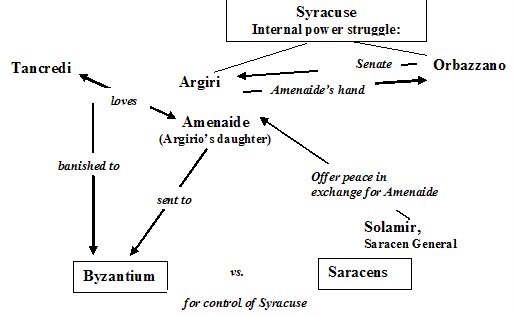
I've been working on my own diagram as I prepare a talk for Washington Concert Opera's upcoming production of Tancredi. Other than the basic context of the famous showpiece "Di tanti palpiti", and a vague memory of the fact that Tancredi has two endings, I knew little of the plot before I started digging in this week. I knew I was in trouble when I was still confused after re-reading the first 3 paragraphs of the synopsis, and the next pargraph began with "As the opera begins..."

Thus, the diagram. Funny, I'm not a "visual" person, but it's tremendously helpful to plot out places, characters, and relationships. I even do it on the inside front cover of multi-generational epic novels, and my book club members mock me for it.

Warsaw Concerto

OK, I promised the story (scroll down on the link), for what it's worth. Please keep in mind that the pitiful state of my longterm memory is legendary, so the details are sketchy.

From age 7-15, I took lessons with a lovely lady who was the only piano teacher in my very small hometown. When I was 15, she signed me up for a competition and assigned me a transcription of Richard Addinsell's Warsaw Concerto. I worked hard, and I think I played the shit out of it. And all I remember was the scathing remarks from the judges about the unsuitability of the material for a serious competition.

I had always played the piano for pleasure, really. And I lived in an active but isolated musical environment. At that age I had yet to hear a concerto, or a symphony, or an opera, for that matter. There was plenty about music I didn't understand, and there's no doubt that the Warsaw, in all of its unrefined, unrestrained, and populist glory, was neither Beethoven nor Liszt.

The only thing I knew then, though, was that I played that music for all I was worth, and it wasn't good enough for the classical music snobs. Obviously, they formed a club for which I would never qualify. An experience that would be repeated multiple times over the next several decades, and, in spite of (or because of?) which, I seem to have become a fringe member of the musical establishment.

Audition Comments with a Twist

"It didn't capture my attention at all.....it was so non-emotional."
"It was very brave of you to be very ethereal and intimate."
"It was like being at some horrible Sunday lunch with a child getting up to sing out of tune. It was a complete and utter mess."

I waded into the American Idol morass a week or so ago, and as I was sitting here minding my own blogging business, I got a call from a friend who urged me to turn on the TV right away. Seems that the young lady who talks of her serious voice study was singing. (Actually, this is not the same one I referred to in my previous posting, but it's all so confusing I couldn't explain it if I wanted to. Lots of readers have tried to set me straight.)

No matter. What I just heard, though, was pretty sobering. And the comments above are not mine, but the Idol audition panel's. The only thing that's important here is that, bless her heart, she sang hopelessly and woefully out of tune. And she told millions of viewers that she studies opera. Public relations like this, we don't need. Ouch.